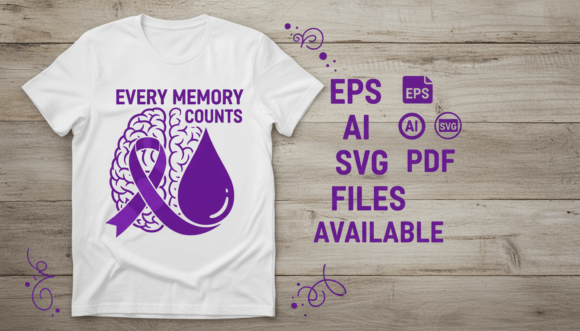
Dementia Support T-Shirt Design
As a designer and embroidery product reviewer, I often evaluate machine embroidery designs with a critical eye, considering how they translate from digital file to finished product. The Dementia Support T-Shirt Design is one that carries emotional weight and visual appeal, but its success depends on how well it adapts to real-world embroidery scenarios. Let’s break down what this design offers and where it shines—or falls short.
First Impressions: A Design with Purpose
The Dementia Support T-Shirt Design immediately conveys a sense of empathy and awareness. The central theme—a creative brain illustration paired with a purple awareness ribbon—feels intentional and meaningful. The layout is balanced, with the text “Every Memory Counts” positioned to complement the imagery without overwhelming it. The design has a soft, approachable aesthetic that works well for both personal and commercial use.
From a visual standpoint, the design uses a mix of satin stitch and fill stitch techniques to create depth and texture. The color palette is limited but effective, with purple as the dominant hue. This makes it easy to adapt to different fabric colors, though it does require careful consideration of thread contrast.
Real-World Embroidery Performance
When testing the Dementia Support T-Shirt Design on various fabrics, I found it performs best on medium-weight cotton and polyester blends. The stitch density is moderate, which means it doesn’t cause puckering or distortion on most standard garments. However, on thin or stretchy materials, the design can appear slightly less defined, especially around the edges of the brain illustration.
This design is ideal for custom apparel like t-shirts, sweatshirts, and tote bags. It also translates well to embroidered patches, aprons, and baby clothes. For small hoop sizes, the design may need to be split into sections, which could affect the overall cohesion. That said, it’s not overly complex, so it should work for most home embroidery machines.
Where to Use It Carefully
While the Dementia Support T-Shirt Design is versatile, there are some situations where it might not perform as well. On dark fabrics, the purple elements can lose some vibrancy, so it’s worth testing with a light-colored background first. Similarly, on textured or stretchy materials, the design may not sit as smoothly as it would on a flat, non-stretch fabric.
For curved surfaces like caps or hats, the design may require repositioning to avoid distortion. Tiny lettering in the “Every Memory Counts” text could be challenging on smaller projects, so it’s important to ensure the font size is appropriate for the intended application. Dense stitch areas, such as the brain illustration, may benefit from additional stabilizer to prevent shifting during stitching.
Impact on Visual Appeal and Customer Perception
One of the strongest aspects of the Dementia Support T-Shirt Design is its ability to evoke emotion and connect with viewers. As a personalized gift or handmade product, it has the potential to resonate deeply with recipients, especially those affected by Alzheimer’s or dementia. Its clean layout and clear message make it suitable for both commercial and handmade applications.
In terms of visual appeal, the design is well-balanced and professional-looking when stitched correctly. However, poor execution—such as incorrect thread color or improper stabilizer—can diminish its impact. For small shop products or Etsy listings, the design adds value by offering a meaningful, recognizable motif that customers can easily associate with awareness and support.
Practical Designer Notes
Before using the Dementia Support T-Shirt Design in any project, I recommend testing it on scrap fabric. This allows you to assess how the stitches interact with the material and whether any adjustments are needed. Pay close attention to the thread colors—especially if you’re working with dark fabrics, where the purple may not show up as clearly as expected.
Review the stitch density to ensure it’s suitable for your project’s scale. If you’re planning to use it on a large item like a pillow cover or blanket, consider whether the design will maintain its clarity at a larger size. Also, check if the design works in black and white mockups, as this can help determine its versatility across different fabric backgrounds.
For commercial embroidery projects, confirm that the licensing terms allow for resale or redistribution, especially if you’re selling finished items or digital embroidery files. Always use the proper stabilizer for the fabric type, and make sure the hoop size is appropriate for the design’s dimensions.
Best Fit for Different Projects
The Dementia Support T-Shirt Design is particularly well-suited for holiday gifts, wedding gifts, and personalized products that carry an emotional message. It also works well for small business merchandise, craft fair products, and boutique branding. As a printable mockup, it can be used to showcase the design before production, helping customers visualize the final result.
For craft businesses and Etsy sellers, this design offers a unique opportunity to connect with buyers who value meaningful, handmade products. Its simplicity and clarity make it a strong choice for digital product previews and embroidery project kits. However, it’s not ideal for highly detailed or intricate designs that require advanced stitching techniques.
Final Thoughts
The Dementia Support T-Shirt Design is a thoughtful and visually appealing option for embroidery projects that aim to raise awareness and show support. While it has limitations in certain applications, it excels in custom apparel, tote bags, and personalized gifts. With proper preparation and attention to detail, it can become a valuable addition to any designer’s portfolio or small shop inventory.